

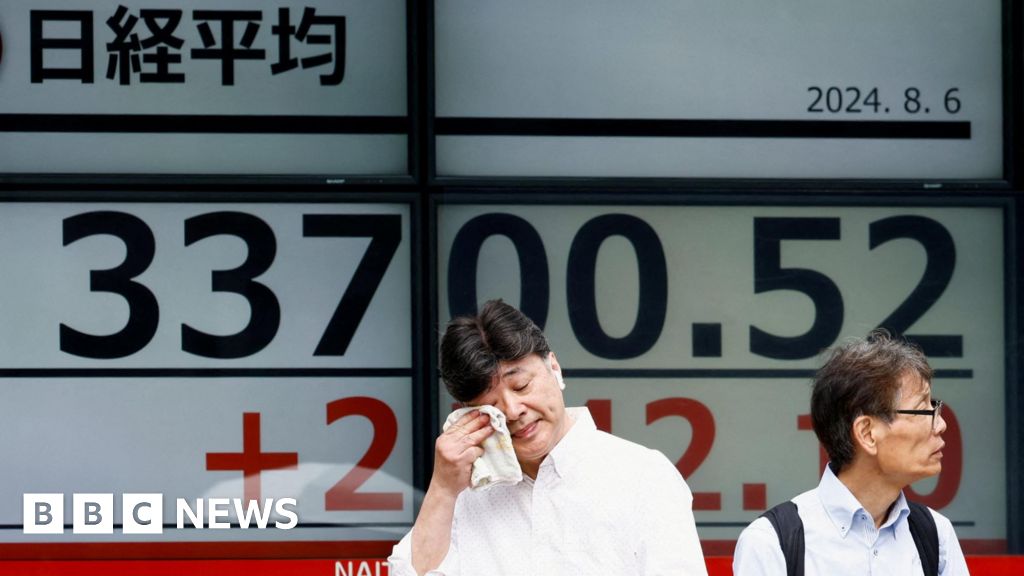

It sent the yen soaring against the dollar making Japanese stocks – and the country’s exports – more expensive for foreign investors and buyers.
Fears that the American economy is heading for a slowdown also hit shares in the UK, Europe and in the US.
Jesper Koll, executive director of Monex Group Japan, said he still had confidence in the country’s stocks despite Monday’s big falls.
“Japan’s fundamentals are strong, recession risks are nil, and corporate leaders are dead-set on raising capital returns,” he told the BBC.
Shares in South Korea also regained some ground on Tuesday. The Kospi stock index rose 3.5% after falling 8.8% on Tuesday – its worst trading session since the global financial crisis of 2008.

Taiwan’s main stock index jumped almost 3.4%, after a record 8.4% drop on Monday.
The news comes after share prices tumbled globally on Monday.
Weak jobs data in the US on Friday sparked concerns about growth in the world’s largest economy.
It also stoked speculation about when, and by how much, the Federal Reserve will cut interest rates.
“Markets are very volatile at the moment and will likely stay volatile until the Fed decision in September. So we wouldn’t rule out rapid swings in both directions,” said Stefan Angrick, a senior economist with Moody’s Analytics.
There are also concerns that shares in big technology companies, particularly those investing heavily in artificial intelligence (AI), have been overvalued and are now facing difficulties.
Last week, chipmaker Intel announced major layoffs, as well as disappointing financial results.
There is also speculation that rival Nvidia, which has been one of the main beneficiaries of the boom in demand for AI technology, will delay its latest product launch.
https://www.bbc.com/news/articles/c1d77xe2p26o,
GO TO SAUBIO DIGITAL FOR MORE ANSWERS AND INFORMATION ON ANY TOPIC



